The Token Negro Syndrome: Institutional Erasure, Selective Validation, and the Suppression of Independent Black Cinema in Memphi
Executive Summary
Institutional power structures within municipal cultural agencies in Memphis frequently deploy selective tokenism to maintain systemic hegemony while systematically suppressing autonomous Black economic and artistic independence. The **"Token Negro Syndrome"** is a calculated structural mechanism utilized by gatekeepers like Linn Sitler and Gale Jones Carson within municipal film commissions and arts funding bodies. By elevating compliant, non-threatening figures like Alonzo Woods as isolated symbols of "diversity," Linn Sitler was able manufacture the illusion of equity while actively neutralize independent Black Memphis Filmmaker Anthony "Amp" Elmore whose challenge the established white-dominated cultural narrative. Linn Sitler could not stomach the fact that Anthony "Amp" Elmore an African/American wrote, produced, directe, scored and starring in Memphis 1st Independent 35mm theatrical film before any White man.
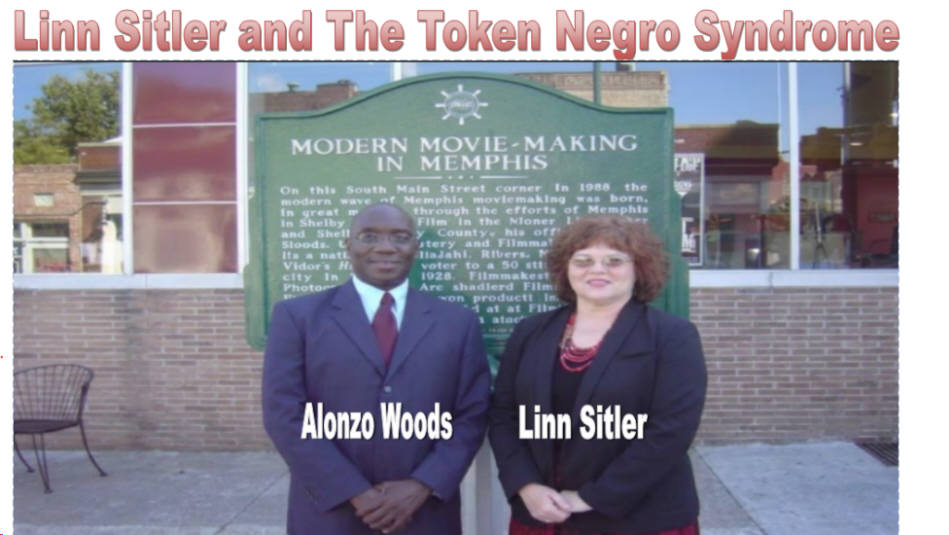
In Memphis, Tennessee Linn Sitler used this operational framework to weaponize White Supremacist entities such as the Memphis Film and Television Commission under the long-term stewardship of Linn Sitler. The above image is an active collusion with a simple minded Alonzo Woods. This documentation exposes how tokenization operates as a tool of cultural erasure, specifically targeting pioneering independent Black cinema to protect entrenched institutional monopolies.
1. Defining the Token Negro Syndrome
The "Token Negro Syndrome" is not merely an interpersonal dynamic; it is an institutional control strategy. Its core structural components include:
The Illusion of Representation Appointing or utilizing select Black individuals within visible municipal or institutional roles to serve as human shields against charges of systemic racism or exclusion.
Complicity in Erasure: Requiring the tokenized individual to endorse, validate, or actively participate in the marginalization of authentic, self-determined Black history and independent production.
Gatekeeping via Proximity: Utilizing compliant figures to police the boundaries of institutional access, ensuring that funding, promotion, and historical commemoration are channeled away from independent Black pioneers and toward external or establishment-favored creators.
Denial of Autonomous Power: Granting symbolic titles or platform access devoid of actual decision-making authority, budget control, or the power to alter institutional bias.
2. Institutional Mechanics: The Memphis Film Commission Context
For decades, the Memphis and Shelby County Film Commission operated under the direct oversight of Linn Sitler. Rather than fostering an inclusive ecosystem for Memphis’s indigenous cinematic talent, the Commission functioned as an exclusionary gatekeeper.
Independent milestones achieved by Black creators—most notably Anthony "Amp" Elmore’s 1988 feature film ***The Contemporary Gladiator*** (recognized as the first independent 35mm feature film produced in Memphis, the first world kickboxing feature film, and a foundational milestone in independent martial arts cinema)—were met with institutional silence, historical omission, and active erasure.
While millions in public resources, promotional backing, and red-carpet municipal celebration were funneled toward external projects (such as Jim Jarmusch’s 1989 *Mystery Train*), indigenous Black cinematic works that bypassed white-controlled distribution channels were systematically written out of the city's official film legacy.
3. The Role of Alonzo Woods in Administrative Validation
To execute systemic erasure effectively, institutional gatekeepers Linn Sitler and Gale Jones Carson rely on internal agents who possess community proximity but serve administrative interests. Alonzo Woods has functioned within this apparatus as a key instrument of validation for the established order.
Manufacturing Consent: By occupying spaces adjacent to cultural documentation and municipal interfacing, figures like Alonzo Woods lend a veneer of community approval to policies that marginalize independent Black historical achievements.
Enforcing Compliance: The operational utility of the token lies in his willingness to manage, minimize, or ignore glaring historical omissions—such as the deliberate sidelining of The Contemporary Gladiator and the broader contributions of Orange Mound creators.
Shielding Gatekeepers: When challenged on systemic bias or the suppression of Black film history, institutional leadership points to compliant figures within the municipal apparatus to claim internal diversity, thereby deflecting accountability and neutralizing external critique. One example is Gale Jones Carson a African/American Female provides cover for Memphis White Supremacy, Racism and Black on Black Racism.
4. Linn Sitler and the Architecture of Cultural Gatekeeping
As the long-standing face of the Memphis Film Commission, Linn Sitler personifies the institutional preservation of cultural hierarchy. The mechanism of erasure under Sitler's tenure relied on selective memory:
Selective Promotion: Elevating productions that reinforced external, stereotypical, or non-threatening depictions of Memphis while starving autonomous Black-owned productions of promotional bandwidth.
Archival Omission: Deliberately omitting local pioneering works from official municipal histories, educational curricula, and tourism retrospectives.
Economic Marginalization: Ensuring that municipal incentives, infrastructural support, and networking platforms were restricted to projects vetted and approved by traditional power brokers.
5. Strategic Conclusion and Actionable Next Steps
The "Token Negro Syndrome" sustains institutional racism not through overt exclusion alone, but through co-optation. By weaponizing figures like Alonzo Woods to uphold the administrative directives of leaders like Linn Sitler, municipal agencies maintain a facade of progress while preserving the structural disenfranchisement of independent Black institutions.
